Korean Language Course vs 1:1 Tutor vs App: What Actually Works
Korean language course, app, or 1:1 tutor? Compared on the thing that decides progress — how many minutes per hour you actually spend speaking.

The variable that actually matters
Searching for a Korean course returns apps, YouTube channels, academies, and 1:1 tutors all mixed together, and comparing them by price alone does not help. What separates outcomes is how much time you spend producing Korean, and how often that production gets corrected.
Learning splits into input (listening, reading) and output (speaking, writing). Input scales fine alone; output only improves with a partner and correction. Most plateaus come from stacking more input while postponing output indefinitely.
The four paths side by side
| Path | Strength | Limit |
|---|---|---|
| Learning apps | Cheap, habit-forming, genuinely good for vocabulary and the alphabet | No correction of your speech, and little practice building sentences yourself |
| Free video and materials | High-quality explanation, broad coverage, strong for understanding grammar | You have to sequence it yourself, and nothing checks your output |
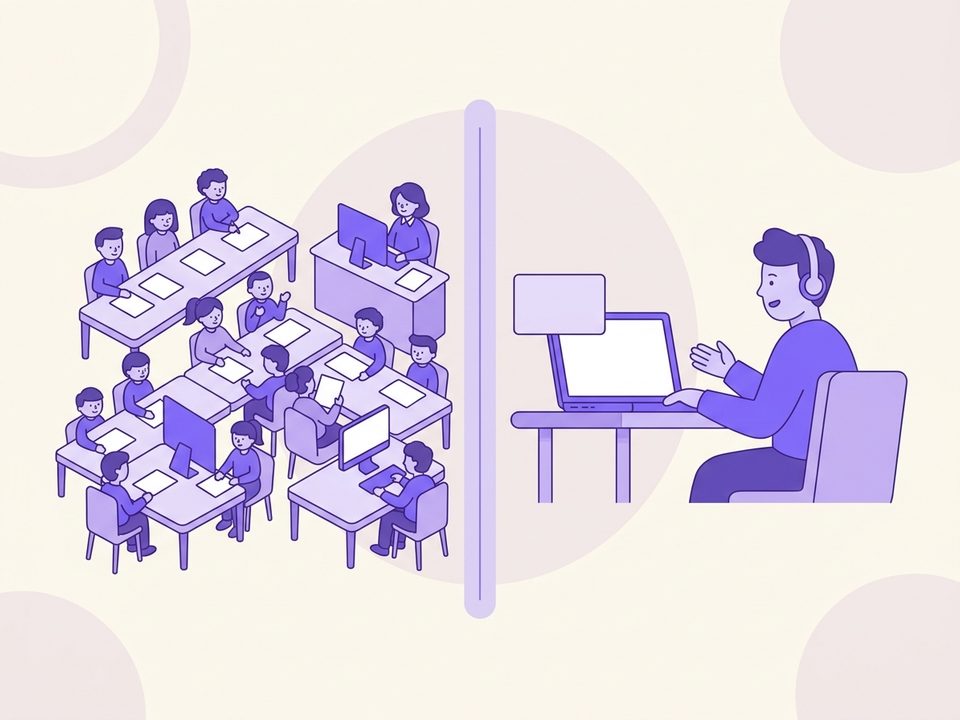
| Group classes and academies | A fixed curriculum and schedule create accountability | Speaking time is divided by class size, and pacing follows the average student |
| 1:1 online tutors | The whole session is your speaking time, paced to your goal | The highest hourly cost, and quality varies with who you pick |
Read that way, apps and 1:1 lessons are not competitors — they do different jobs. Spending paid tutor time memorizing vocabulary is wasteful, and trying to replace speaking practice with an app does not work either.
What to pick at each stage
- Absolute start (before you can read Hangul) — apps and free material are enough. Hangul takes days; this is not where money helps.
- Basic patterns — take the grammar explanation from free material and the correction from a tutor. Even one session a week keeps you pointed the right way.
- The speaking plateau — you understand but cannot produce. This is the point where 1:1 time earns its cost.
- Exam prep (TOPIK) — a tutor who knows the format and can correct writing saves a lot of self-study time.
If budget is tight, shortening sessions is usually better than spacing them out. That is why Haru's default lesson is 25 minutes: frequent short speaking sessions build the habit better than occasional long ones.
Check yourself
Which factor separates these learning paths the most?
What to check when picking a tutor
- Experience matched to your goal — conversation, absolute beginner, and TOPIK prep call for different skills.
- The language they can explain in — at beginner level, a tutor who can explain in your language speeds things up dramatically.
- Whether prices are published — if you have to ask, you cannot compare.
- Time zone overlap — a schedule you can actually keep matters more than any other single factor.
Whichever path you pick, keep one measure: how many minutes you spent speaking Korean out loud this week. A method that never moves that number rarely changes the outcome, however long you stay with it.
Frequently asked questions
Can I learn Korean with an app alone?
For vocabulary and learning to read Hangul, yes. Speaking is different — it needs a partner and correction, which an app cannot provide. Splitting the job (app for input, tutor for output) is the practical answer.
Group class or 1:1 lessons?
It depends on what you need. A group class gives you a curriculum and accountability; 1:1 maximizes speaking time. Just account for the arithmetic — in a group, your speaking time is divided by the number of students.
What is the best way to learn Korean?
Rather than picking one method, split the two halves of the problem: build vocabulary and grammar understanding daily through apps and free material, and get speaking time plus correction from 1:1 sessions with a native speaker.
Find the tutor that fits you