TOPIK Prep Tutor: 1:1 Writing Feedback, First Lesson Half Off
TOPIK Test Prep: 1:1 Online Korean Tutors by Level
Prepare for TOPIK I & II with tutors experienced in test strategy and writing correction, level by level.



20 verified TOPIK Prep tutors

Floriana
Korean, English, Spanish, Italian, Russian, French, Portuguese5.0 (5)25 min $20.90Book for $10.45
+10yrs Exp
English, Japanese, Chinese, Spanish, Thai, Korean5,212 lessons completed25 min $19.80Book for $9.90
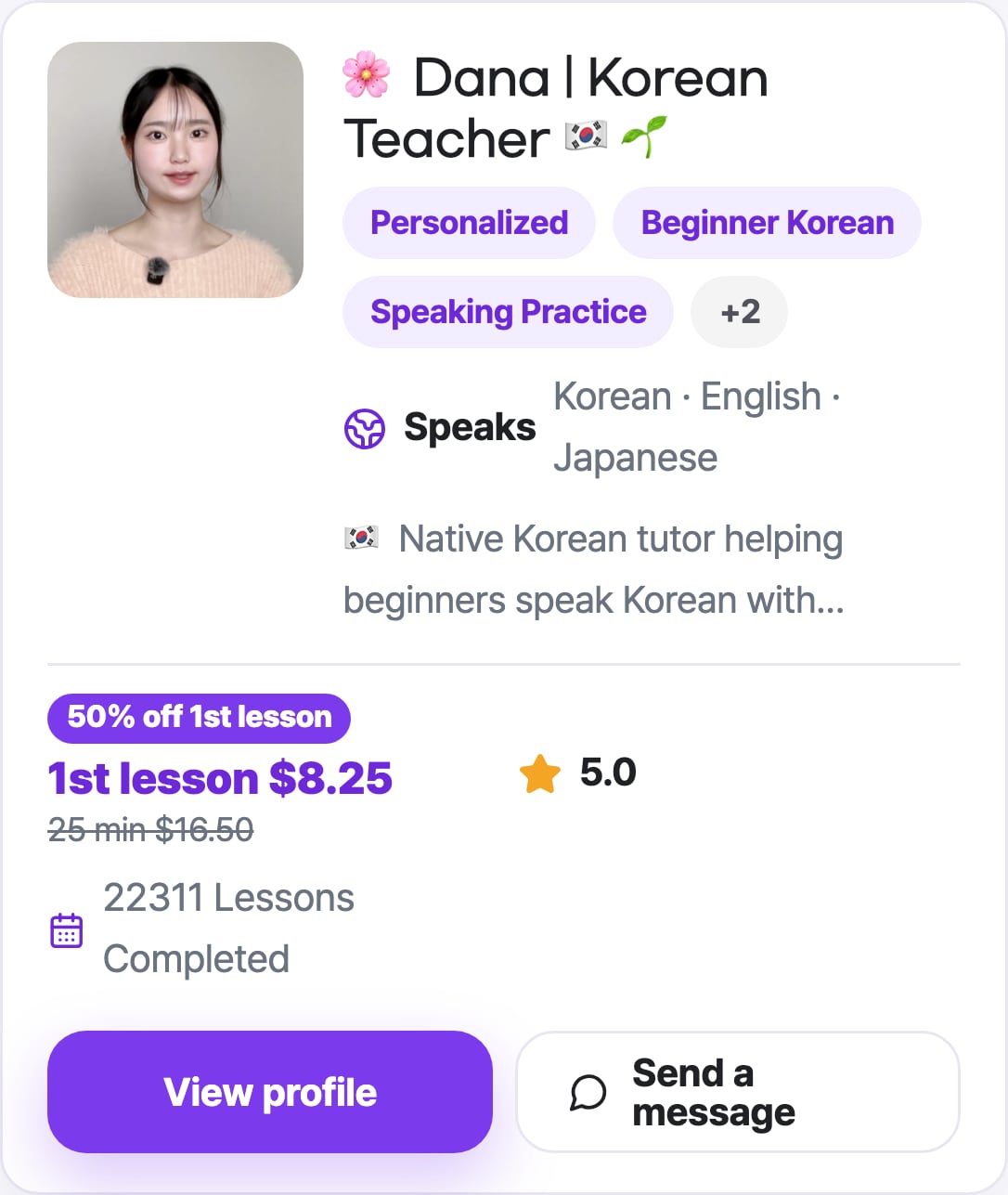
Dana
Korean, English, Japanese5.0 (7)25 min $16.50Book for $8.25
Aria Marriot
English, Korean5.0 (7)25 min $11Book for $5.50
Keunhee Lee
Korean, English, Japanese5.0 (7)25 min $8.80Book for $4.40
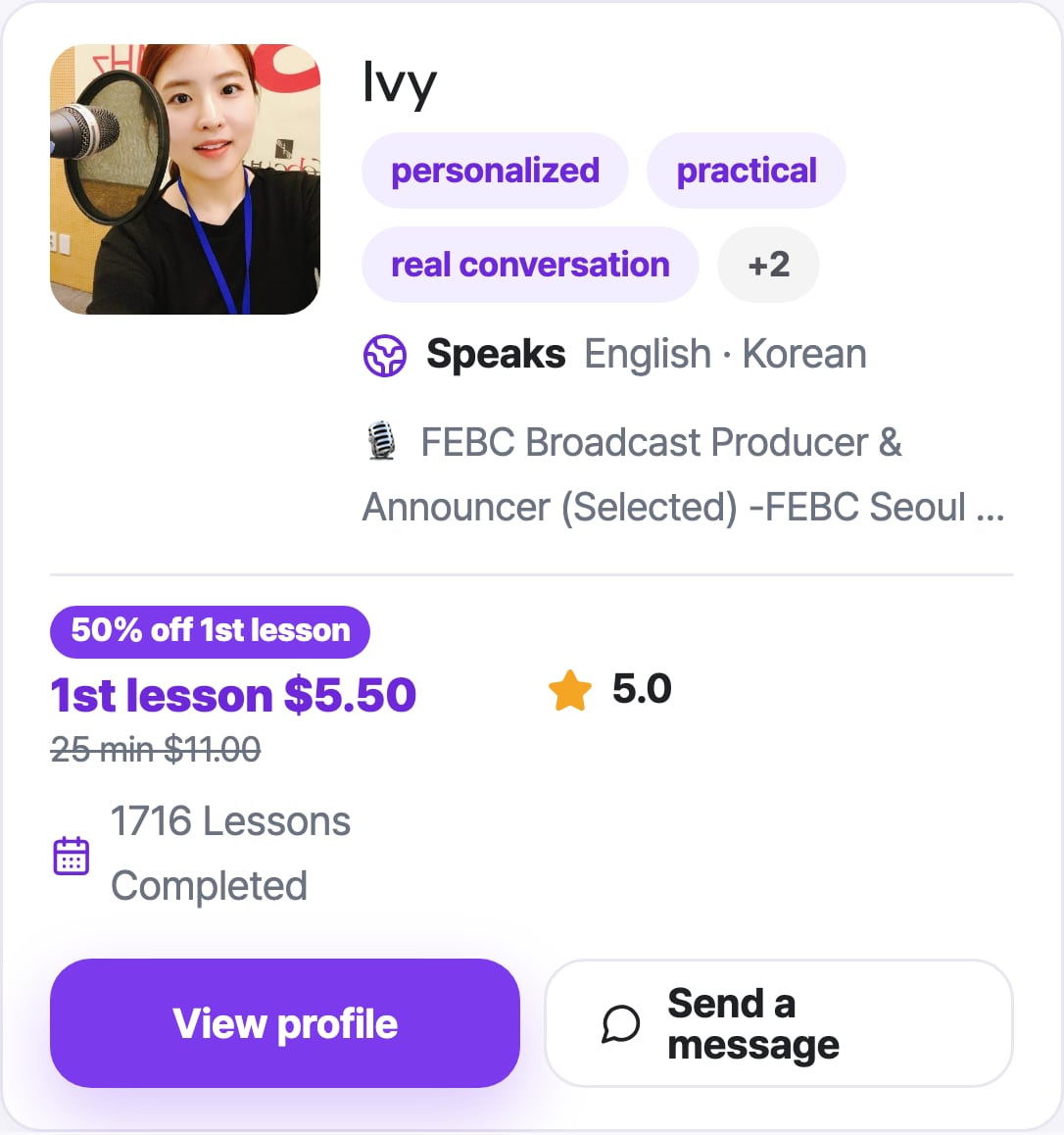
Ivy
English, Korean5.0 (6)25 min $11Book for $5.50
Koco쌤
Korean, English5.0 (6)25 min $11Book for $5.50
Goeun Ssem
Korean, English, Japanese, Chinese5.0 (5)25 min $11Book for $5.50
More tutors



Tutors by subject
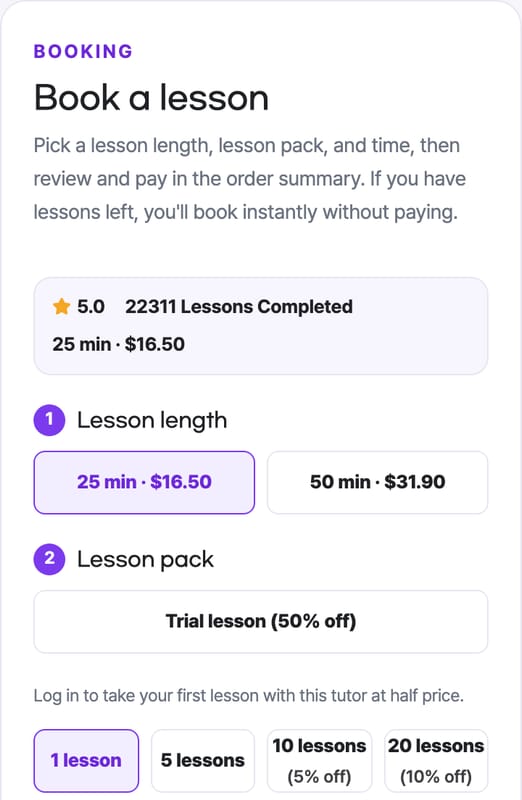
Lesson prices
$7.70 to $20.90per 25-minute lesson
The typical band among prices tutors set themselves. 10- and 20-lesson packs are discounted, and 50-minute lessons have their own price. Each tutor's exact price is on their profile.
How Haru works
Pick a tutor
Compare specialties, experience, reviews, and prices to find your match.
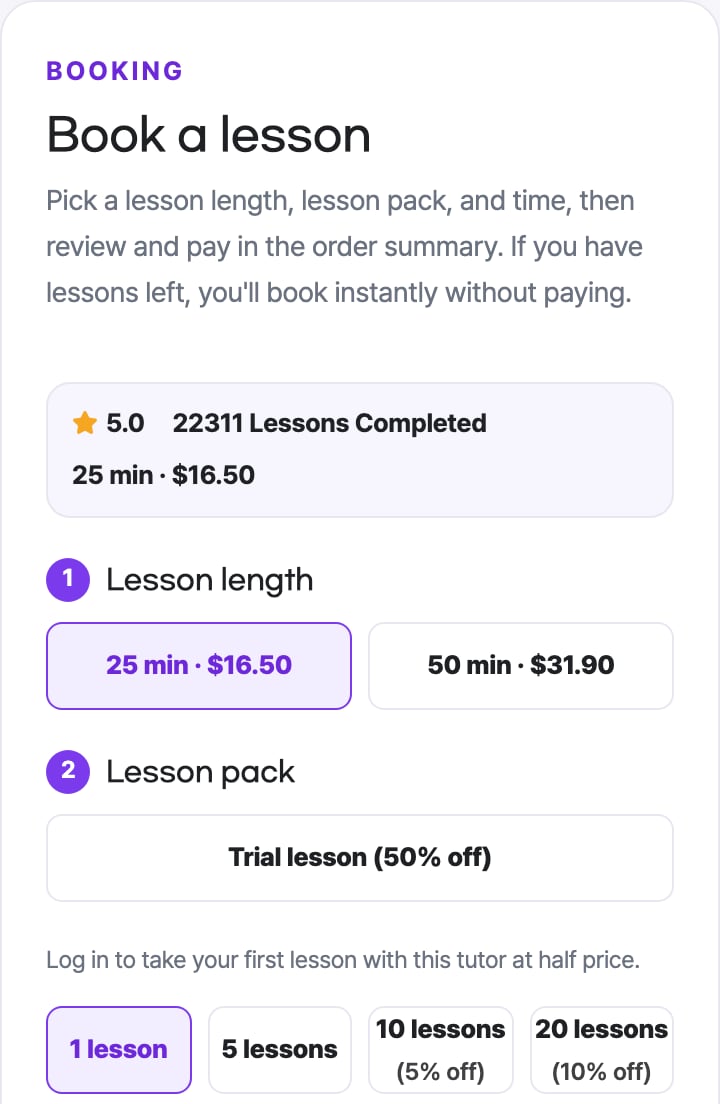
Book a time
Choose from the tutor's published schedule, shown in your own time zone.
Meet on video
Join from your bookings on Zoom, in the app or your browser.
Student reviews
From students who completed real lessons
my seonsaengnim is awesome!!
수업을 하면서 배우는 게 정말 많아요! 감사합니다!
Dana is very friendly, and she gave great tips on how to speak like a native speaker. Highly recommend!
Every lesson is so fun and so personalized to me and my learning needs. So friendly and supportive! Can’t recommend enough!
Where TOPIK self-study hits a wall
Past papers alone will get you partway through TOPIK, but self-study stalls at two points. First, writing (questions 51–54 on TOPIK II): it's hard to judge your own answers against the scoring rubric, and without correction you repeat the same mistakes. Second, level strategy: which questions to fight for and which to let go changes with your target level, and an experienced tutor can set priorities against the actual cut-off lines.
In 1:1 lessons you can schedule mock-test reviews, writing correction, and drills on your weak question types around your exam date. Tutors with TOPIK experience note it on their profiles. For a level-by-level study roadmap, see the TOPIK guide below.
TOPIK levels explained: which one do you need?
TOPIK is two separate exams. TOPIK I (levels 1–2) tests listening and reading only; TOPIK II (levels 3–6) adds writing. Your level is decided by score bands within each exam.
| TOPIK I | TOPIK II | |
|---|---|---|
| Levels | 1–2 | 3–6 |
| Sections (questions) | Listening 30, reading 40 | Listening 50, writing 4, reading 50 |
| Time | One period, 100 min (listening + reading) | Period 1: 110 min (listening + writing); period 2: 70 min (reading) |
| Total score | 200 (100 per section) | 300 (100 per section) |
| Score bands | Level 1: 80–139; level 2: 140–200 | Level 3: 120–149; 4: 150–189; 5: 190–229; 6: 230–300 |
| Writing items | None | Q51–52 sentence completion (short answer); Q53 a 200–300-character expository text; Q54 a 600–700-character argumentative essay |
| Level | Exam | Rough proficiency | Commonly needed for |
|---|---|---|---|
| Levels 1–2 | TOPIK I | Basic everyday Korean | Basic proof of study; some visa point systems |
| Levels 3–4 | TOPIK II | Intermediate: following classes and daily work | University admission (often 3+), graduation requirements (often 4) |
| Levels 5–6 | TOPIK II | Professional and academic Korean | Graduate school, professional jobs, some residency tracks |
Alongside the paper-based test (PBT) there is TOPIK IBT, taken on a computer. The level system is the same frame, but sessions and registration run separately, so if you want more chances to sit the exam, watch both calendars. Registration, dates, and admission tickets all live on the official site (topik.go.kr). The tutors on this page help with the part after that: producing the score.
Below 80 on TOPIK I, or below 120 on TOPIK II, no level is awarded. Results are valid for two years from the announcement. The computer-based TOPIK IBT runs six times in 2026 and carries the same weight as the paper test, but it uses a different score scale (TOPIK II IBT level 3 is 191–290, for example), so the bands above apply to the paper test only. A separate TOPIK Speaking test runs three times in 2026, in Korea.
Turning past papers and mock tests into points
Working through past papers is necessary, but solving them is not what raises your score. What you do with the wrong answers is.
- Sit one full past paper under real timing. Untimed practice predicts nothing about exam day.
- Sort your misses by question type. Patterns like "late listening sets" or "reading sequence questions" emerge fast.
- Drill only those weak types. It is far faster than re-covering everything.
- Get writing (questions 51–54) corrected by a person. You cannot see your own deductions against the rubric.
Test prep with a tutor is delegating steps 2–4 of that cycle. Writing especially is where a few rounds of correction fix recurring deductions, the fastest score-per-hour improvement on the exam.
A sample 8-week TOPIK plan with 25-minute lessons
Here is an example for a TOPIK II target of level 3–4. It mixes two or three 25-minute lessons a week with self-study. Use the 25 minutes for what you can't do alone: writing correction, finding why you missed a question, and talking through grammar out loud. Past-paper practice and vocabulary happen outside the lesson.
| Week | Lessons (25 min ×) | In the lesson | On your own |
|---|---|---|---|
| 1 | 2 | Share your target level and test date; use one recent past paper to pick your weakest section | Sit one full past paper under real timing |
| 2 | 2 | Sort listening and reading misses by question type and find the cause | 20 minutes a day on your two weakest question types |
| 3 | 3 | Writing Q51–52 (sentence completion): learn the answer pattern, get answers corrected | Write past-paper answers for Q51–52; list the connectors you keep needing |
| 4 | 3 | Writing Q53 (200–300-character expository text): structure and correction | Write two Q53 answers against the clock |
| 5 | 3 | Writing Q54 (600–700-character essay): outlining and correction | Three Q54 outlines and one full essay |
| 6 | 2 | Mock-test review: time allocation and which questions to let go | One more full past paper under real timing |
| 7 | 3 | Fix recurring deductions; one more Q54 essay corrected | Review your error log and corrected answers |
| 8 | 2 | No new material: run through your exam-day timing plan | Shift your daily rhythm to the exam's start time |
That is 20 lessons, about 8 hours 20 minutes of lesson time. The cost is the tutor's price × 20. A 20-lesson pack is currently 10% off, and the first lesson with each tutor is 50% off. If you're preparing for TOPIK I (levels 1–2), swap the writing weeks (3–5) for vocabulary and grammar work on listening and reading.
How to pick a TOPIK tutor on HaruMeet
The tutor list on this page puts tutors whose profiles mention TOPIK, exams or levels first. It sorts rather than filters, so other tutors appear too. Check these four things on each profile:
- Specific TOPIK experience: look for what they do, such as "TOPIK II writing correction" or level-by-level lessons, rather than the word TOPIK alone.
- The language they explain in: while you still need grammar explained, pick a tutor whose profile lists English.
- Open times in your time zone: the weekly schedule on the profile is shown in your own time zone. Make sure you can book two or three lessons a week for the weeks before the exam.
- Reviews and price: look for exam mentions in reviews, and compare the 25- and 50-minute prices. The 50-minute price is set separately by each tutor.
Because the first lesson with each tutor is 50% off, you can try two or three tutors before you commit. In that first lesson, bring your target level, your test date, and a recent past-paper score or one written answer. That's enough for a tutor to set a direction in 25 minutes.
TOPIK test dates and how to register
There are six paper-based sittings in 2026 (the 104th to 109th). Which of them run abroad, and on what dates, varies by session and country. Candidates outside Korea register with their country's local host, not on topik.go.kr, and overseas registration windows differ from Korea's, so follow the local host's notice.
| Session | Overseas test date | Results | Singapore / Australia / NZ |
|---|---|---|---|
| 104th | Korea only (11 Jan) | 12 Feb | — |
| 105th | 11–12 Apr | 29 May | Singapore 12 Apr; Sydney and Auckland 11 Apr |
| 106th | 17 May, Asia only | 25 Jun | None |
| 107th | 4–5 Jul | 13 Aug | None |
| 108th | 17–18 Oct | 10 Dec | Singapore and Australia 18 Oct (NZ cancelled) |
| 109th | 15 Nov, Asia only | 22 Dec | None |
The first 2027 sitting, the 110th, is scheduled for Sunday 10 January 2027 in Korea and Asia (registration in Korea: 8–14 December 2026). The full 2027 calendar and the list of overseas countries hadn't been published as of 21 October 2026.
- Singapore: Singapore Korean International School (skis.kr). It hosted the 105th and 108th in 2026.
- Australia: Korean Education Centre, Consulate General in Sydney (auskec.kr). The 108th used seven venues in Sydney, Brisbane, Melbourne, Perth and Canberra; fees were A$50 for TOPIK I and A$65 for TOPIK II.
- New Zealand: Korean Education Centre in New Zealand, Auckland (nzkoreanedu.com). The next test is expected in Auckland in April 2027, with applications from mid-January 2027.
- Elsewhere: find your local host in the overseas host list published on topik.go.kr.
Once you have a date, count back and start the 8-week plan above. Registration usually closes two to three months before the test; for the October 2026 test, Australia's window was 6–24 July. Register first, then study.
Frequently asked questions
Should I take TOPIK I or II?
Most goals (university admission, employment) require TOPIK II (levels 3–6); TOPIK I covers levels 1–2 and is closer to a basics check. If you have a target level, say so in your first lesson, because the curriculum changes with it.
Can I get writing correction only?
Yes. Ask your tutor to structure lessons around writing. A common format focuses on answer structure and scoring points for each of questions 51–54.
Is it worth it with only weeks left?
In the final stretch, mock-test review and writing correction beat learning new grammar. Tell your tutor the time you have left and they'll set priorities.
How much do lessons cost?
Tutors set their own rates; the range at the top of this page shows current 25-minute prices. Your first lesson with each tutor is 50% off, and packs are currently 5% off for 10 lessons and 10% off for 20 (no discount on 5).
When is the next TOPIK in Singapore or Australia?
In 2026 both countries held the April and October sittings (the 105th and 108th). As of 21 October 2026 the 2027 overseas dates hadn't been published. The next sitting, the 110th on 10 January 2027, is listed for Korea and Asia, but Singapore hadn't announced whether it will host it. Watch skis.kr for Singapore and auskec.kr for Australia.
How do I register for TOPIK outside Korea?
Through your country's local host, not on topik.go.kr. Overseas registration windows differ from Korea's and usually close two to three months before the test, so check the local host's notices early.
How long are TOPIK results valid?
Two years from the date results are announced. Work back from when your university or employer needs the score to pick your session.
Is TOPIK IBT scored the same as the paper test?
It carries the same weight, but the score scale is different. Paper TOPIK II level 3 is 120–149, while IBT TOPIK II level 3 is 191–290, so check which format a score comes from before comparing.
Learning guides
Worth a read before your first lesson
 TOPIK Test: How to Prepare, Level by Level
 How to Learn Korean: A Beginner's Guide to Studying Online
 Korean Lessons Online: What They Cost and How to Choose
 Where to start learning Korean as a beginner
 How to Speak Korean: Practice That Builds Real Fluency
 Learning Korean with K-pop: from lyrics to real conversation
Your first lesson is 50% off
Compare profiles, reviews and prices, then book in your own time zone.
Photos: Tlrmq, CC BY-SA 3.0; hyolee2, CC BY-SA 3.0; Smiley.toerist, CC BY-SA 4.0; Teemeah, CC BY-SA 4.0, Wikimedia Commons