Japanese Alphabet: Hiragana, Katakana, and Kanji Explained
The Japanese alphabet is really three scripts. What hiragana, katakana, and kanji each do, how many characters you need, and the order to learn them.
Why three scripts instead of one
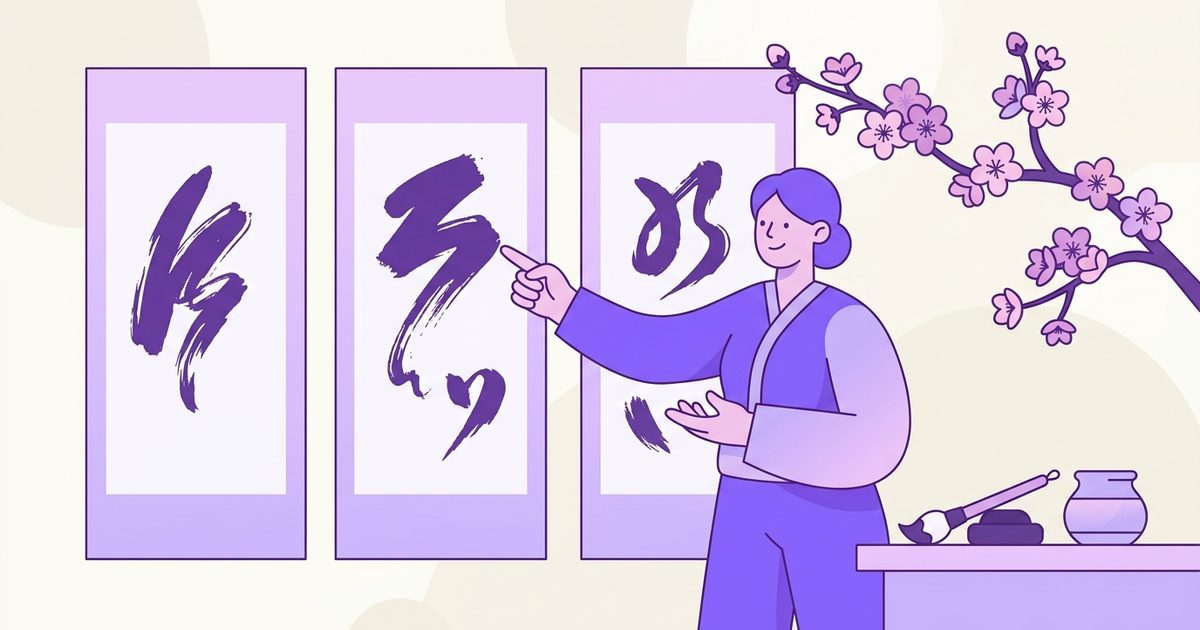
Searching for "the Japanese alphabet" does not return one answer, because Japanese runs three scripts side by side in the same sentence. 私はコーヒーを飲みます ("I drink coffee") contains kanji (私, 飲), hiragana (は, を, みます), and katakana (コーヒー) all at once.
Historically, Japan adopted Chinese characters first, then simplified them into two kana sets to write the grammatical endings Chinese characters could not represent. The division of labor stuck: kanji carry meaning, kana carry grammar.
There is a practical payoff, too. Japanese does not use spaces between words, so the alternation between meaning-bearing kanji and grammar-bearing kana is what visually marks where words start and end. A sentence written entirely in hiragana is genuinely harder to read, not easier.
What each script is for
| Script | How many | What it is used for |
|---|---|---|
| Hiragana (ひらがな) | 46 basic characters | Grammar — particles and verb endings — plus native words with no kanji |
| Katakana (カタカナ) | 46 basic characters | Loanwords, sound effects, emphasis, brand names |
| Kanji (漢字) | 2,136 in the standard set | The meaning-carrying stems of nouns, verbs, and adjectives |
| Romaji (ローマ字) | The 26 Latin letters | Typing, signage, acronyms — not a native writing system |
So "how many letters are in the Japanese alphabet" has a conditional answer: 92 kana (46 + 46) get you started reading, while newspapers and general books assume the 2,136 jōyō kanji on top of that.
Kanji has two kinds of readings
The hard part about kanji is not the count but that most characters have more than one reading. Each typically carries an on'yomi — a reading derived from Chinese — and a kun'yomi, the native Japanese word with the same meaning.
| Kanji | Kun'yomi (native) | On'yomi (Sino-Japanese) |
|---|---|---|
| 山 (mountain) | yama — when it stands alone | san — inside compounds, as in 富士山 (Fujisan) |
| 人 (person) | hito | jin / nin — as in 日本人 (nihonjin, Japanese person) |
| 食 (eat) | ta(beru) — 食べる, to eat | shoku — as in 食事 (shokuji, a meal) |
There is a rough tendency: a kanji standing alone usually takes its kun'yomi, while one inside a two-character compound usually takes its on'yomi. Exceptions are common enough that learning readings word by word beats memorizing the rule.
The order to learn them in
- Hiragana, 46 characters — the skeleton of every sentence, so it comes first. Most learners are reading it within a week.
- Katakana, another 46 — you will meet it first on menus and signs, since loanwords are everywhere. Budget extra time for the look-alike pairs シ/ツ and ソ/ン.
- Kanji — never as a standalone list, always attached to words. At beginner level, the hundred or so used in numbers, days, and basic verbs is plenty.
- Treat romaji as a typing tool only. Leaning on it delays the moment kana becomes automatic.
The day-by-day method for memorizing the kana is covered in the hiragana and katakana guide; this page is about what the scripts are and why they coexist, that one is about how to get them into memory.
Check yourself
Which script writes loanwords like コーヒー (coffee)?
Where learners stall after the kana
The usual plateau after the kana is being able to sound words out without understanding them. Script and vocabulary are separate jobs, and without kanji the word boundaries stay invisible, so reading speed does not improve either.
Learning the characters and reading the language are different stages. If you know all the kana but sentences still stall, the gap is vocabulary and kanji — fill them in that order.
Frequently asked questions
How many letters are in the Japanese alphabet?
Japanese has three scripts rather than one alphabet. The kana total 92 characters — 46 hiragana and 46 katakana — and the standard kanji set adds 2,136 more. To start reading, the 92 kana are enough.
What is the difference between hiragana and katakana?
They represent the same sounds but do different jobs. Hiragana writes grammar — particles and endings — and native words; katakana writes loanwords, sound effects, and emphasis. They are two character sets for one sound inventory.
Do I have to learn kanji?
For speaking alone you can postpone it. But Japanese has no spaces between words, and kanji is what marks where words begin and end — so reading eventually requires it. Learning it word by word rather than as a list is the practical route.
Find the tutor that fits you