
How to Say Hello in Korean — 안녕하세요 and 12 More Greetings
안녕하세요 is hello in Korean almost anywhere — but not on the phone. Which greeting fits when, how to say goodbye, and the mistakes that give you away.

The default: 안녕하세요 covers almost everything
If you learn one Korean greeting, make it 안녕하세요 (annyeonghaseyo). It literally asks something closer to "are you at peace?", but in practice it is an all-purpose hello: morning, afternoon, or evening, with someone you just met or someone you see daily. Because it is already a polite form, it is very hard to misuse.
It breaks into five syllables: an-nyeong-ha-se-yo. The sound English speakers most often miss is the ㅇ at the end of 녕. It is the -ng of "sing", not a hard g. Letting the final 요 rise slightly makes the greeting sound warm rather than flat.
Three levels: 안녕, 안녕하세요, and 안녕하십니까
Korean greetings change shape with the relationship. The same root 안녕 branches into casual, polite, and formal versions, and picking the wrong one reads as either rude or oddly stiff. When you are unsure, 안녕하세요 is always the safe choice.
| Korean | Romanization | Who you use it with |
|---|---|---|
| 안녕 | annyeong | Close friends and people younger than you (casual) |
| 안녕하세요 | annyeonghaseyo | Almost every situation — strangers, shops, work |
| 안녕하십니까 | annyeonghasimnikka | Presentations, news broadcasts, the military, formal events |
| 여보세요 | yeoboseyo | Only when answering the phone |
Note that 안녕 is for friends only. Greeting someone you just met with the casual form can land as rude even if you are the same age. Korean generally waits for the other person to suggest dropping the polite forms.
Why Korean has no everyday "good morning"
Learners often look for the Korean equivalents of "good morning" and "good evening". In everyday Korean they mostly do not exist: 안녕하세요 covers all hours. There is 좋은 아침 ("good morning"), but it is a light workplace expression borrowed from English patterns, and it sounds odd with someone you have just met.
Korean varies its greetings by how long it has been since you last met, not by the clock. For someone you have not seen in a while you say 오랜만이에요 (oraenmanieyo, "long time no see"), and to ask how they have been, 잘 지냈어요? (jal jinaesseoyo?). Both come up far more often than any time-of-day greeting.
Saying goodbye: 가세요 vs 계세요
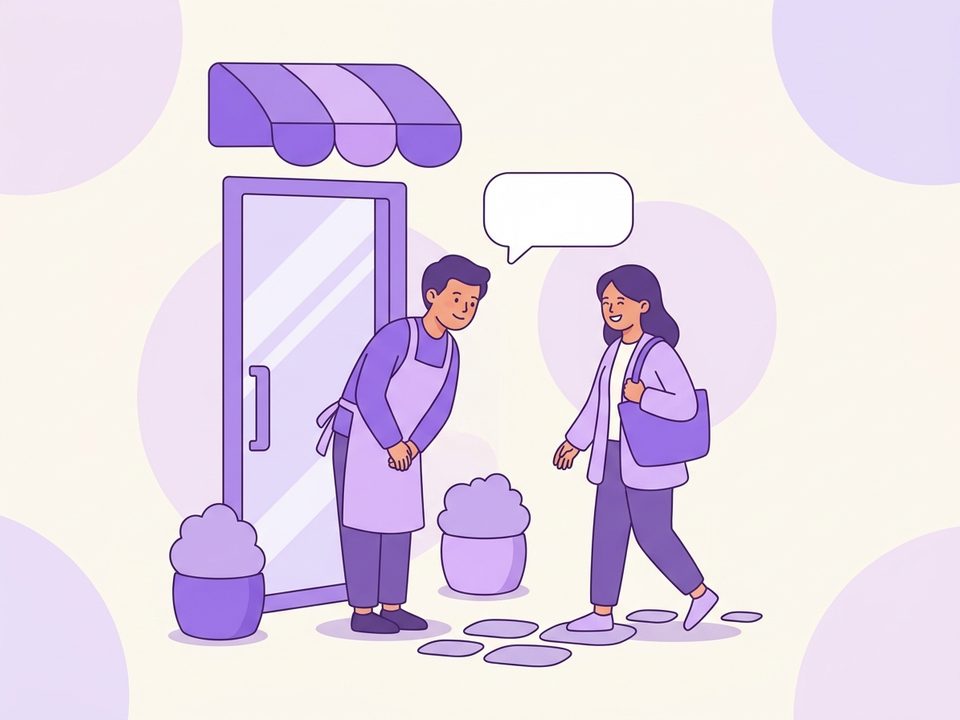
Korean splits goodbye by who is leaving. If the other person is going, say 안녕히 가세요 (annyeonghi gaseyo, "go in peace"). If you are the one leaving and they are staying, say 안녕히 계세요 (annyeonghi gyeseyo, "stay in peace"). Walking out of a shop, the customer says 계세요 and the staff says 가세요.
Between friends both collapse into 안녕 or 잘 가 (jal ga, "go well"). Ending a phone call, Koreans often use 들어가세요 (deureogaseyo). And when you leave the office before your colleagues, 수고하셨습니다 (sugohasyeotseumnida, "thank you for your hard work") functions as the real goodbye.
12 more Korean greetings by situation
| Korean | Romanization | Meaning and when to use it |
|---|---|---|
| 반갑습니다 | bangapseumnida | "Nice to meet you" — first meetings and introductions |
| 오랜만이에요 | oraenmanieyo | "Long time no see" |
| 잘 지냈어요? | jal jinaesseoyo? | "How have you been?" |
| 처음 뵙겠습니다 | cheoeum boepgetseumnida | Formal first greeting — business settings |
| 어서 오세요 | eoseo oseyo | "Welcome" — said to guests and customers |
| 수고하셨습니다 | sugohasyeotseumnida | "Thanks for your hard work" — also a work goodbye |
| 잘 먹겠습니다 | jal meokgetseumnida | Said before eating, like "itadakimasu" |
| 잘 먹었습니다 | jal meogeotseumnida | Said after eating, thanking whoever fed you |
| 안녕히 주무세요 | annyeonghi jumuseyo | "Good night" — to someone older or senior |
| 잘 자요 | jal jayo | "Sleep well" — friends and close relationships |
| 다녀오겠습니다 | danyeoogetseumnida | "I'm heading out" — said when leaving home |
| 들어가세요 | deureogaseyo | Ending a call or seeing someone off |
Check yourself
The phone rings and you pick up. What do you say first?
Greeting mistakes beginners make
- Answering the phone with 안녕하세요 — the first word on a call is 여보세요.
- Swapping 가세요 and 계세요 — the choice depends on who is physically leaving.
- Using 안녕 with a peer you just met — same age still starts with polite forms.
- Skipping the bow — a small nod of the head is part of the greeting, not optional decoration.
The short version: when you are unsure, it is always 안녕하세요. Switch to 여보세요 on the phone, check who is physically leaving before you say goodbye, and you will rarely get a greeting wrong as a beginner.
Frequently asked questions
How do you say hello in Korean?
Say 안녕하세요, romanized annyeonghaseyo and pronounced an-nyeong-ha-se-yo. It works at any hour of the day and with anyone, including people you are meeting for the first time, because it is already a polite form.
What is the difference between 안녕 and 안녕하세요?
안녕 is the casual form, reserved for close friends and people younger than you. 안녕하세요 is the polite form and is safe almost everywhere. When in doubt, use 안녕하세요 — being slightly too polite is never a problem in Korean.
Do Koreans say "good morning" in Korean?
Rarely. The phrase 좋은 아침 exists but is mostly a casual workplace expression. In practice Koreans use 안녕하세요 regardless of the time of day, and vary greetings by how long it has been since they last met instead.
Find the tutor that fits you